



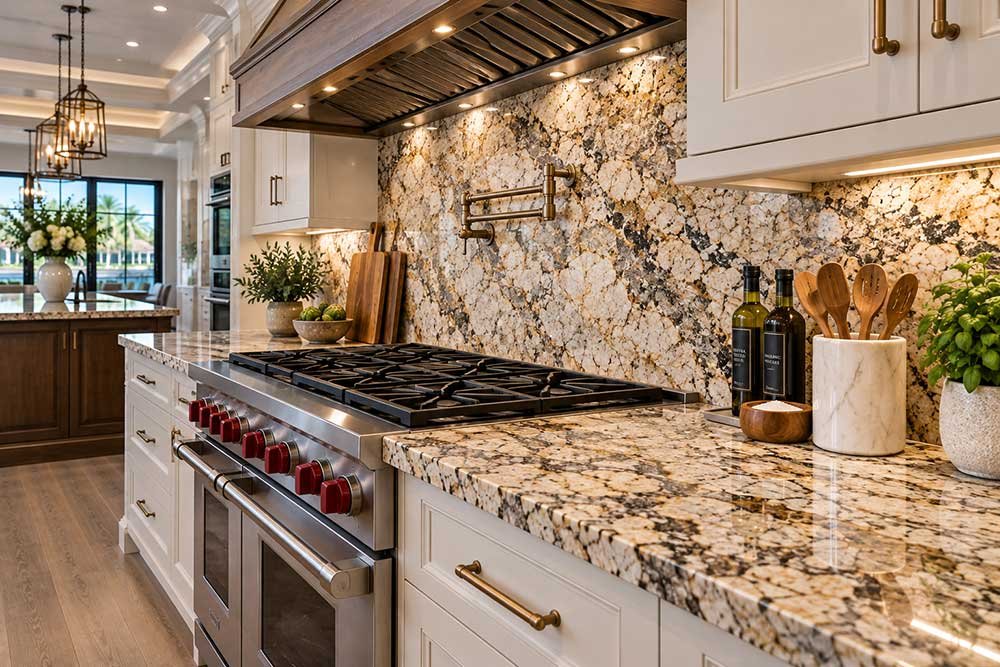
Granite vs. Quartzite: Which Is Easier to Maintain?
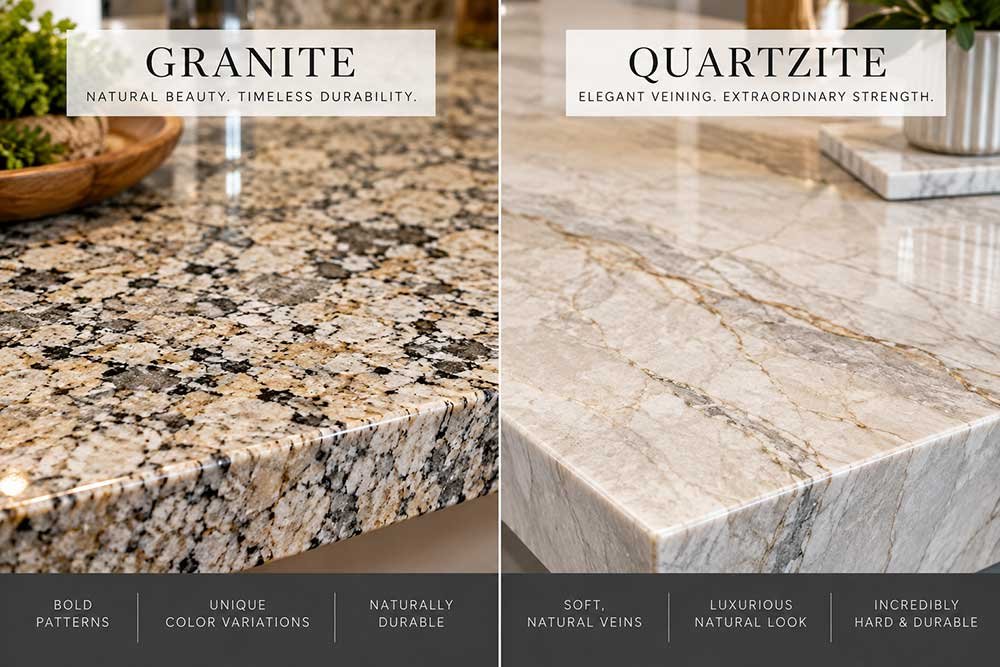
Granite and quartzite are both relatively easy to maintain. Routine cleaning, prompt spill removal, and appropriate sealing when needed can help either natural-stone countertop remain beautiful for decades.
Homeowners sometimes assume that natural-stone countertops require complicated maintenance. In reality, everyday care for granite and quartzite is generally straightforward.
For most kitchens, maintenance consists of wiping up spills, cleaning the surface with appropriate products, avoiding unnecessarily harsh chemicals or abrasives, and monitoring whether the stone needs resealing.
The exact maintenance requirements depend more on the characteristics of the individual slab, finish, and sealer than on simply choosing granite or quartzite.

Routine natural-stone countertop care is simple: clean spills promptly, use appropriate cleaning products, and maintain the stone according to its specific requirements.
Quick Answer: Is Granite or Quartzite Easier to Maintain?
For most homeowners, the maintenance difference between granite and quartzite is relatively small.
Both can be easy-care countertop materials. Some slabs may require more frequent attention to sealing than others because natural-stone porosity varies.
The best approach is to learn the care requirements of the actual stone installed in your home rather than relying on a universal maintenance schedule.
How Should You Clean Granite and Quartzite?
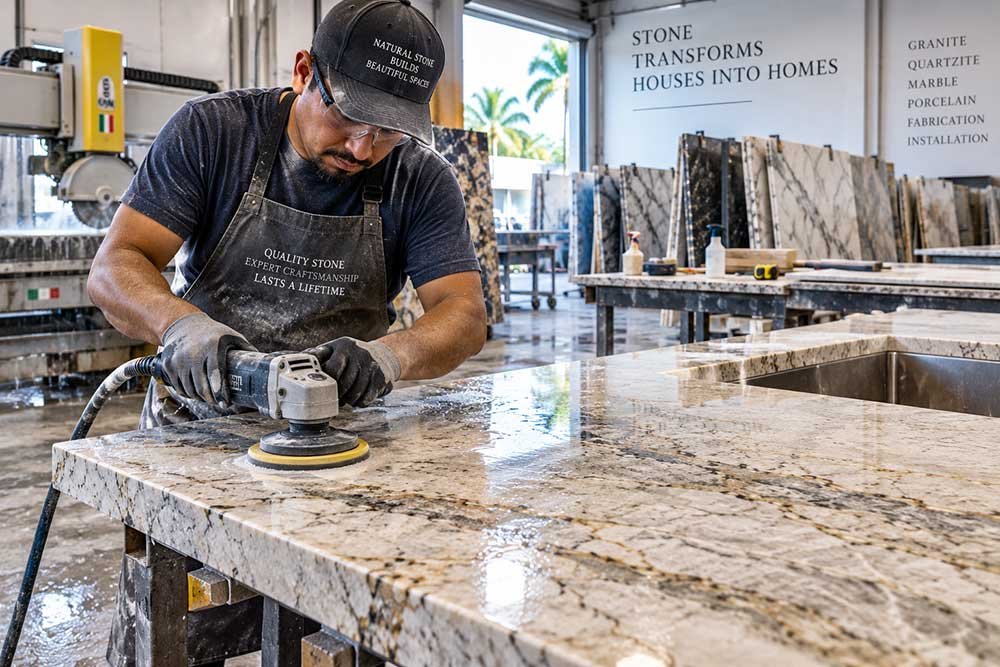
For routine cleaning, remove crumbs and loose debris, then wipe the countertop with a soft cloth or non-abrasive sponge and a cleaner appropriate for natural stone.
Follow the directions provided by the stone-care product manufacturer and your fabricator. Avoid assuming that every general-purpose household cleaner is appropriate for natural stone.
Daily Cleaning
Use a soft cloth or non-abrasive sponge with an appropriate natural-stone cleaner for routine countertop cleaning.
Spills
Blot and clean spills promptly, particularly oils, coffee, wine, sauces, food coloring, and other strongly pigmented substances.
Food Preparation
Use cutting boards rather than preparing food directly on the stone surface.
Hot Cookware
Use trivets or heat pads even though granite and quartzite both provide excellent heat resistance.
Heavy Appliances
Lift heavy appliances when possible instead of dragging them across the countertop, especially if grit or debris may be trapped underneath.
Edges & Corners
Avoid striking exposed countertop edges and corners with heavy cookware, tools, or appliances.
Granite vs. Quartzite Maintenance Comparison
| Maintenance | Granite | Quartzite |
|---|---|---|
| Daily Cleaning | Easy | Easy |
| Routine Care | Low | Low |
| Spill Cleanup | Prompt cleanup recommended | Prompt cleanup recommended |
| Sealing | Depends on the particular stone and sealer | Depends on the particular stone and sealer |
| Cutting Boards | Recommended | Recommended |
| Trivets | Recommended | Recommended |
| Abrasive Cleaners | Avoid unless specifically approved | Avoid unless specifically approved |
| Long-Term Care | Generally straightforward | Generally straightforward |
How Often Should Granite or Quartzite Be Sealed?
There is no single sealing schedule that applies to every granite or quartzite countertop.
Natural stones vary in porosity, and sealers vary in formulation and expected service life. A countertop should therefore be evaluated based on the actual stone and the sealing product being used.
Some countertops may maintain good resistance to moisture for an extended period, while another stone may require attention sooner.
Don't Automatically Reseal Every Year
A common piece of advice is that every natural-stone countertop must be resealed once a year. That is too broad to apply to every installation.
Resealing should be based on the characteristics of the stone, the sealer manufacturer's recommendations, the amount of countertop use, and whether the existing protection is still performing properly.
Applying unnecessary products can create additional cleaning or appearance issues, so determine whether the countertop actually needs treatment before applying another sealer.
What Should You Avoid Using on Natural Stone?
| Avoid | Why | Better Practice |
|---|---|---|
| Abrasive Scouring Pads | May affect the surface finish | Use a soft cloth or non-abrasive sponge |
| Abrasive Powders | May dull or alter some finishes | Use an appropriate stone cleaner |
| Unapproved Acidic Cleaners | Can affect acid-sensitive minerals or finishes | Use products appropriate for the actual stone |
| Unknown Harsh Chemicals | May interact with the stone, finish, or sealer | Check product compatibility first |
| Heavy Scraping | Can potentially damage the finish | Use appropriate cleaning methods |
| Wax Unless Recommended | Can create unwanted buildup | Follow professional stone-care recommendations |
A Simple Natural-Stone Maintenance Routine
Maintaining granite or quartzite does not need to be complicated.
| When | What to Do |
|---|---|
| Daily | Wipe away crumbs, spills, cooking residue, and standing liquids. |
| As Needed | Clean with a product appropriate for natural stone. |
| During Cooking | Use cutting boards and trivets. |
| Periodically | Inspect seams, caulked areas, edges, and frequently used countertop areas. |
| When Needed | Evaluate whether the stone's existing sealer is still providing appropriate protection. |
Maintaining Natural-Stone Countertops in South Florida
For homeowners in Pompano Beach, Fort Lauderdale, Deerfield Beach, Coral Springs, Lighthouse Point, and throughout Broward County, granite and quartzite can both be practical choices for heavily used kitchens.
Large islands and open kitchens often serve as food-preparation areas, dining spaces, work areas, and gathering places. Fortunately, neither granite nor true quartzite requires complicated daily maintenance to handle this type of use.
A few consistent habits can make a significant difference: clean spills promptly, use appropriate products, protect the surface during food preparation, and address maintenance issues before they become larger problems.
Granite Maintenance
- Simple routine cleaning
- Prompt spill cleanup
- Use appropriate natural-stone products
- Sealing depends on the particular stone
- Use cutting boards and trivets
- Avoid harsh abrasives
Quartzite Maintenance
- Simple routine cleaning
- Prompt spill cleanup
- Use appropriate natural-stone products
- Sealing depends on the particular stone
- Use cutting boards and trivets
- Confirm the characteristics of the actual stone
Which Is Easier to Maintain: Granite or Quartzite?
For most homeowners, both granite and quartzite are relatively low-maintenance countertop materials.
Neither has a universal maintenance advantage because individual natural stones can differ in porosity and other characteristics.
Choose the stone you prefer based on appearance, performance, budget, and the characteristics of the actual slab, then follow the appropriate care recommendations for that specific countertop.