
Learn about quartzite durability, colors, maintenance, fabrication, installation, costs, and how to choose the right quartzite slab for your South Florida home.
Quartzite has become an important natural-stone option for homeowners who want the beauty and movement associated with luxury stone combined with excellent hardness and durability.
For kitchens, bathrooms, large islands, bars, and other surfaces, quartzite can provide dramatic natural veining and a distinctive appearance that cannot be duplicated exactly from one slab to another.
But choosing quartzite requires more than finding a color you like.
Different stones sold under quartzite-related commercial names can have different characteristics. Homeowners should understand the actual slab, its intended application, maintenance requirements, fabrication considerations, and how the stone will work within the overall design.
This guide explains what South Florida homeowners should know before selecting quartzite countertops.
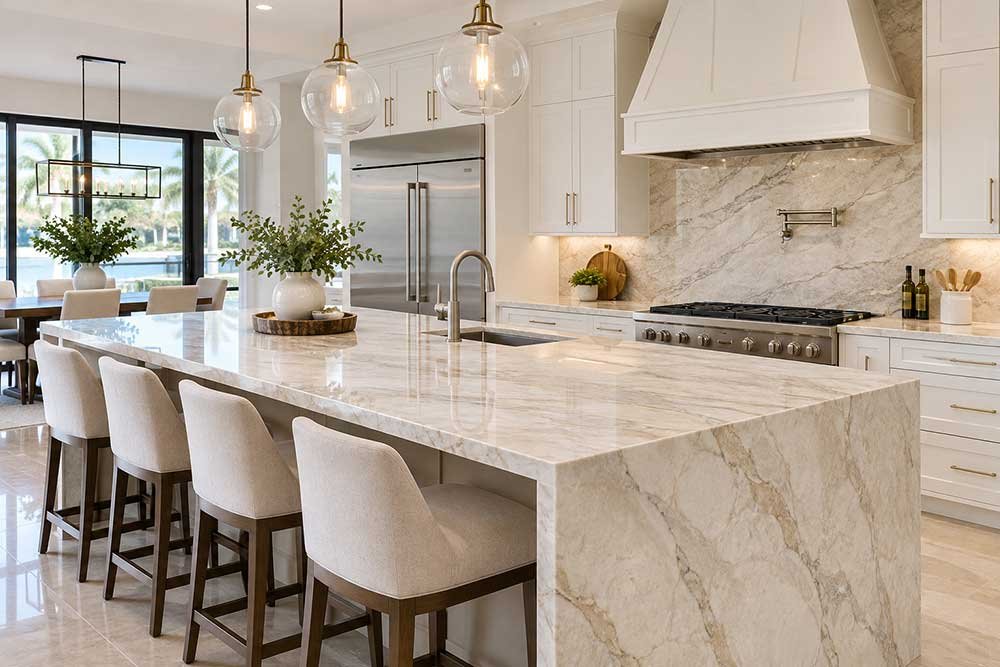
Natural quartzite can combine light colors, flowing veins, and the durability needed for a hardworking kitchen.
Yes. True quartzite can be an excellent natural-stone countertop material for South Florida homes.
Its hardness, heat resistance, natural beauty, and variety of patterns make it suitable for many kitchens, bathrooms, islands, and other residential applications.
The key is selecting the right individual stone for the application and having it properly fabricated, installed, supported, sealed when appropriate, and maintained.
| Topic | What We'll Cover |
|---|---|
| What Is Quartzite? | How natural quartzite forms and why it is different from quartz and marble. |
| Durability | Hardness, scratching, heat, staining, chips, and everyday kitchen use. |
| Colors & Styles | Light quartzites, dramatic veining, Taj Mahal, and other design options. |
| Maintenance | Cleaning, sealing, stain prevention, and long-term care. |
| Cost | What affects the total price of a quartzite countertop project. |
| Fabrication | Slab layout, seams, edges, sink openings, cooktops, and large islands. |
| Florida Homes | Choosing quartzite for South Florida kitchens, bathrooms, and outdoor areas. |
| Choosing a Slab | What to inspect before approving quartzite for fabrication. |
Homeowners throughout Pompano Beach, Fort Lauderdale, Deerfield Beach, Lighthouse Point, Coral Springs, and surrounding Broward County communities can use quartzite to create everything from light coastal kitchens to dramatic luxury islands.
Because every natural-stone slab is different, seeing the full quartzite slab before fabrication is one of the most important steps in choosing the right countertop for your home.
Quartzite is available in a wide range of natural colors and patterns, from quiet cream and white slabs to dramatic stones with bold veins and movement.
One of the biggest reasons homeowners consider quartzite is its appearance.
Depending on the stone, quartzite can feature soft neutral backgrounds, sweeping veins, subtle mineral patterns, dramatic movement, or combinations of colors that make the countertop a major design feature.
Because quartzite is natural stone, the exact appearance comes from the individual slab—not simply the stone name.
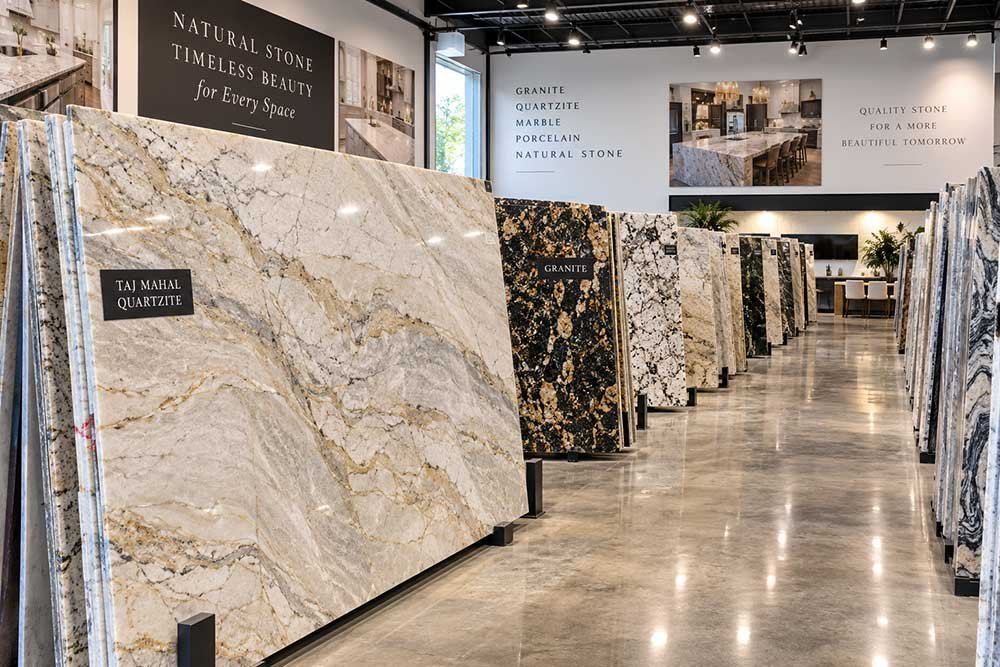
Viewing full quartzite slabs makes it easier to compare color, veining, movement, and natural variation before fabrication begins.
Quartzite is not limited to white or gray. Natural mineral content can produce a surprisingly broad range of colors.
Light quartzites can create bright countertops that work particularly well with white, gray, blue, wood-tone, and dark cabinetry.
Warm cream and beige quartzites can provide a softer alternative to bright white stone and pair naturally with warm wood tones and neutral interiors.
Gray quartzites can range from subtle neutral backgrounds to stones with dramatic charcoal or silver movement.
Natural gold, tan, brown, and warm mineral accents can add depth to kitchens using wood cabinetry or warmer design palettes.
Some natural stones sold within the quartzite market feature striking green, blue, teal, or aqua coloring that can create dramatic statement surfaces.
More dramatic slabs may combine several colors, veins, and mineral patterns across a single piece of stone.
Color is only part of the decision. The amount and direction of movement within the slab can have an even greater effect on the finished countertop.
| Pattern Style | Appearance | Where It Can Work Well |
|---|---|---|
| Subtle | Quiet background with limited movement | Minimalist and contemporary kitchens |
| Soft Veining | Gentle flowing lines across the slab | Coastal, transitional, and luxury interiors |
| Linear Movement | Veins travel predominantly in one direction | Long countertops and waterfall islands |
| Dramatic Movement | Large sweeping veins and strong contrast | Statement islands and focal-point surfaces |
| Complex Mineral Pattern | Multiple colors, formations, and natural movement | Distinctive kitchens where the stone is a major design element |
Taj Mahal is one of the best-known names homeowners encounter when shopping for quartzite.
It is typically recognized for a warm cream or beige background with relatively soft flowing movement rather than extremely high-contrast veining.
That combination can make Taj Mahal easy to coordinate with white cabinets, cream cabinets, natural wood, darker cabinetry, brass or gold-tone hardware, and neutral flooring.
However, natural variation means one Taj Mahal slab can look noticeably different from another. Always evaluate the actual slabs available for your project.
Stone names and inventories change, so homeowners should avoid becoming overly focused on finding one exact commercial name.
A better approach is to first identify the appearance you want and then compare available slabs that fit that design.
| If You Want... | Look For... |
|---|---|
| A marble-inspired kitchen | Light quartzite with flowing gray or neutral veins |
| A warm luxury kitchen | Cream, beige, or gold-toned quartzite |
| A dramatic island | Quartzite with bold movement and high-contrast veins |
| A coastal appearance | Light neutral, blue, gray, or softly patterned stone |
| A contemporary design | Clean backgrounds with controlled movement |
| A one-of-a-kind focal point | Highly distinctive slabs with unusual mineral formations and color |
A small piece of stone may represent only a tiny portion of the complete slab.
The other end of the slab may contain stronger veins, different colors, mineral formations, or significantly more movement.
For a large kitchen island in particular, view the entire slab before fabrication whenever possible.
Highly veined quartzite requires more planning than a visually uniform surface.
Fabrication decisions can determine where the most dramatic portions of the slab appear in the finished kitchen.
Large islands provide an opportunity to display broad sections of natural movement with fewer visual interruptions.
Vein direction and slab layout become especially important when stone continues vertically down the side of an island.
Planning seam locations can help create a more natural transition between adjacent countertop pieces.
Using natural stone as a backsplash can extend the slab's pattern vertically and create a dramatic focal point.
In Pompano Beach, Fort Lauderdale, Deerfield Beach, Lighthouse Point, Coral Springs, and throughout Broward County, quartzite can work with a wide range of architectural and interior styles.
Light cream and white stones can complement coastal and waterfront interiors, while stronger veins and darker colors can create dramatic contemporary kitchens.
Warm neutral quartzites can also work particularly well when remodeling homes with natural wood cabinetry or floors.
Whenever possible, bring samples or accurate references for your cabinetry, flooring, backsplash, wall color, and hardware when comparing slabs.
Stone that looks warm or cool by itself can appear different when placed beside the permanent colors in your home.
There is no single best quartzite color.
The right slab is the one that works with your home's design while providing the natural characteristics and performance appropriate for your project.
Start with the full slab—not simply the stone name—and choose the individual piece of natural stone you want to live with.
True quartzite is an extremely hard natural stone that can provide excellent scratch resistance, heat resistance, and long-term durability in a properly fabricated and installed kitchen.
Durability is one of the main reasons homeowners consider quartzite for kitchen countertops.
True quartzite contains a high percentage of quartz, a naturally hard mineral. This can make it highly resistant to the scratching and everyday wear that kitchen surfaces experience.
However, durable does not mean indestructible. The performance of a finished countertop also depends on the specific stone, fabrication, cabinet support, installation, seams, cutouts, maintenance, and how the countertop is used.
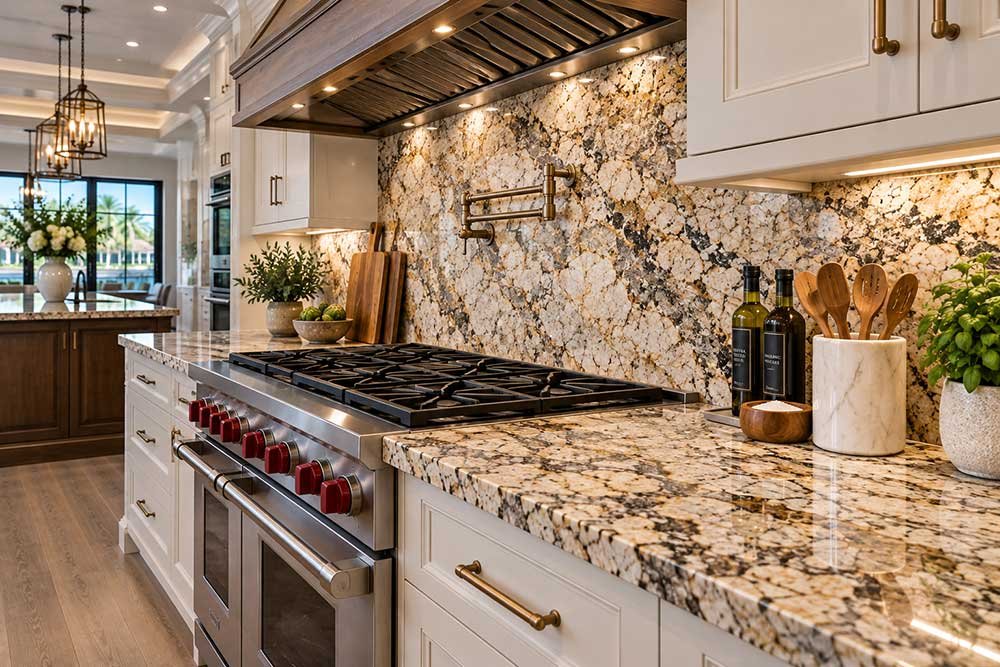
Quartzite's hardness and natural heat resistance can make it an excellent material to consider for hardworking kitchen countertops.
| Performance Area | Quartzite | What Homeowners Should Know |
|---|---|---|
| Scratch Resistance | Excellent | True quartzite is extremely hard, but cutting boards are still recommended. |
| Heat Resistance | Excellent | The natural stone tolerates heat well; trivets remain a sensible precaution. |
| Stain Resistance | Varies | Porosity differs between stones and appropriate sealing may be recommended. |
| Impact Resistance | Very Good | Heavy impacts can still chip edges or vulnerable areas. |
| Daily Kitchen Use | Excellent | Well suited to busy kitchens when properly fabricated, installed, and maintained. |
| Long-Term Durability | Excellent | Natural stone can remain functional for many decades with appropriate care. |
True quartzite provides excellent scratch resistance because quartz is a very hard mineral.
Under normal residential kitchen use, this makes quartzite well suited for areas where dishes, cookware, small appliances, and food preparation are part of everyday life.
That does not mean you should intentionally cut directly on the countertop.
A cutting board protects both your countertop and your knives while also providing a cleaner, dedicated food-preparation surface.
Quartzite may be harder than the knife blade itself, meaning cutting directly on the stone can quickly dull kitchen knives.
Natural quartzite has excellent heat resistance and is well suited for countertops around cooking areas.
However, a finished countertop includes more than raw stone. Sealers, adhesives, repairs, seams, and surrounding materials can react differently to extreme temperatures.
For that reason, using a trivet or heat pad under extremely hot cookware remains a good habit.
Quartzite is often described as stain resistant, but homeowners should not interpret that to mean every quartzite slab is completely stain-proof.
Porosity can vary between individual stones. Some quartzites may absorb liquids more readily than others and may benefit from an appropriate penetrating sealer.
Potential staining substances can include:
The safest approach is simple: clean spills promptly rather than allowing them to remain on the countertop.
True quartzite is primarily composed of quartz and is generally much less susceptible to acid etching than calcite-rich stones such as marble.
However, stones sold commercially under quartzite-related names may not all have identical mineral compositions.
If acid sensitivity is an important concern, discuss the characteristics of the specific slab rather than relying entirely on its commercial name.
Yes. Quartzite is extremely hard, but hardness does not make a countertop immune to impact damage.
A heavy object striking an exposed edge can potentially cause a chip.
Areas that deserve particular care include:
Proper fabrication and support are especially important around these areas.
Like other natural stones, quartzite can crack under sufficient stress.
Potential causes can include severe impact, inadequate cabinet support, excessive unsupported spans, movement beneath the countertop, transportation damage, or stress around openings.
Proper templating, fabrication, support, handling, and installation all contribute to long-term countertop performance.
Quartzite countertops are strong, but they are not designed to function as ladders or platforms.
Standing or sitting on a countertop can place concentrated stress around sink openings, cooktop cutouts, seams, overhangs, and unsupported areas.
Always use a proper ladder or step stool instead.
Yes. True quartzite can be an excellent choice for a busy kitchen because it combines hardness, scratch resistance, heat resistance, and natural-stone durability.
Quartzite can handle the normal activity associated with food preparation and cooking.
Its durability and natural movement can make quartzite particularly attractive for heavily used statement islands.
Large quartzite surfaces can provide durable serving and gathering areas for kitchens designed around entertaining.
Properly installed natural stone can provide decades of useful service without requiring replacement simply because of age.
For homeowners in Pompano Beach, Fort Lauderdale, Deerfield Beach, Lighthouse Point, Coral Springs, and throughout Broward County, quartzite can provide a combination of durability and natural appearance that works well in both everyday family kitchens and higher-end renovations.
It can also be considered for large islands and other heavily used surfaces where homeowners want the stone itself to become an important part of the room's design.
| Do | Avoid |
|---|---|
| Use cutting boards | Cutting directly on the stone |
| Use trivets for very hot cookware | Unnecessary extreme thermal exposure |
| Clean spills promptly | Leaving oils or pigmented liquids sitting for long periods |
| Use stone-appropriate cleaners | Harsh or inappropriate cleaning chemicals |
| Follow sealing recommendations for the specific stone | Assuming every quartzite has identical sealing requirements |
| Use a ladder when reaching high areas | Standing or sitting on the countertop |
True quartzite is one of the harder natural stones commonly considered for residential countertops.
Its combination of hardness, scratch resistance, heat resistance, natural beauty, and potential longevity makes it particularly well suited to kitchens.
The best results still depend on choosing the right slab and combining it with professional fabrication, proper support, careful installation, and appropriate maintenance.
Quartzite countertops are generally straightforward to maintain, but proper cleaning, prompt spill removal, and appropriate sealing when needed can help protect the stone for decades.
One of the most common questions homeowners ask before choosing quartzite is how much maintenance the countertop will require.
For most homeowners, everyday quartzite care is relatively simple. Keep the surface clean, wipe up spills promptly, avoid unnecessarily harsh cleaning products, and follow sealing recommendations appropriate for the specific stone.
The important point is that not every quartzite countertop has exactly the same maintenance requirements.
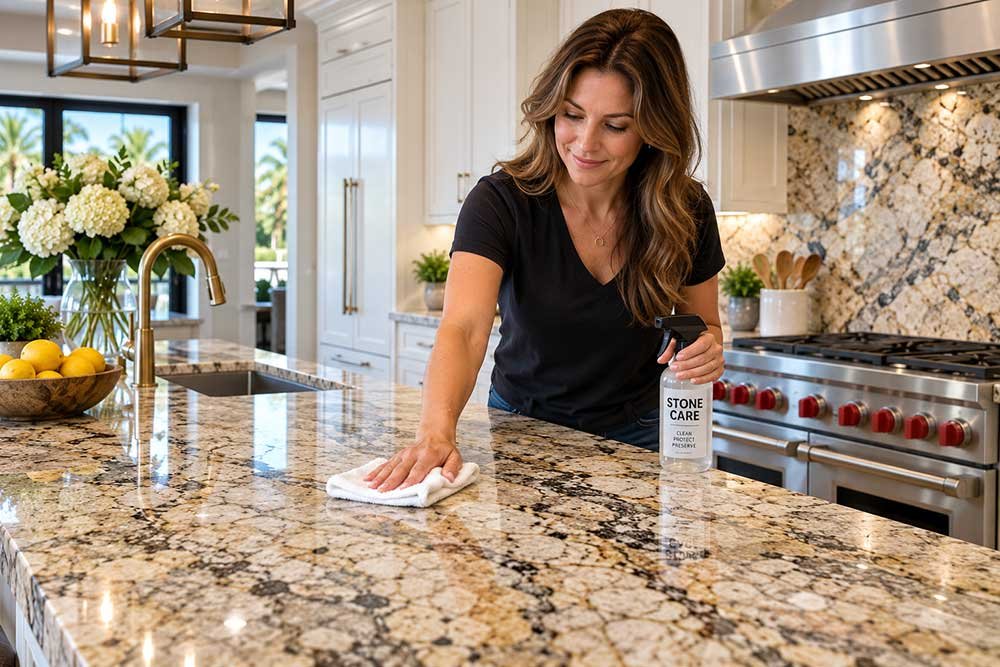
Routine quartzite maintenance is generally simple: clean spills promptly and use products appropriate for natural stone.
For everyday cleaning, start with a soft cloth or nonabrasive sponge and a cleaner appropriate for natural stone.
For many routine messes, warm water and a small amount of mild soap may be sufficient.
After cleaning, remove any soap residue and dry the surface with a clean cloth when appropriate.
| Situation | Recommended Approach |
|---|---|
| Crumbs & Dust | Wipe with a soft cloth. |
| Normal Kitchen Mess | Use warm water and a mild or stone-appropriate cleaner. |
| Liquid Spill | Blot or wipe it up promptly. |
| Oil or Grease | Clean promptly with a product appropriate for natural stone. |
| Dried Food | Soften the residue before gently cleaning rather than aggressively scraping. |
| Routine Maintenance | Follow care recommendations for the specific stone and finish. |
Use products identified as appropriate for natural stone or follow the recommendations provided for your specific countertop.
The goal is to clean the surface without unnecessarily exposing the stone, sealer, seams, or surrounding materials to aggressive chemicals.
A pH-neutral cleaner specifically intended for natural-stone surfaces.
Warm water with a small amount of mild soap can be useful for ordinary countertop cleaning.
Use microfiber cloths, soft towels, or nonabrasive sponges for everyday cleaning.
Always follow the cleaner manufacturer's instructions and any care recommendations for your particular stone.
Avoid unnecessarily harsh, abrasive, or inappropriate cleaners unless they are specifically recommended for the stone and the problem being treated.
Products and cleaning methods that deserve caution include:
When dealing with an unusual stain or residue, identify the problem before applying a strong chemical treatment.
Some quartzite countertops may benefit from an appropriate penetrating sealer because natural-stone porosity can vary.
A penetrating sealer is intended to reduce the rate at which certain liquids can enter the stone, giving homeowners more time to clean spills before they potentially create a stain.
Sealer does not make a countertop completely stain-proof.
Spills should still be cleaned promptly.
There is no universal calendar that applies to every quartzite countertop.
How frequently resealing may be appropriate depends on the specific stone, its porosity, the sealer used, countertop use, cleaning practices, and other conditions.
Follow recommendations based on your actual countertop rather than automatically applying another coat of sealer every 12 months.
Changes in how the surface handles liquids can sometimes indicate that the countertop should be evaluated.
For example, if an area that previously resisted water begins darkening quickly when exposed to moisture, ask your stone professional whether the surface should be tested or resealed.
Do not apply multiple layers of sealer simply because the countertop is older. Additional product is not automatically better.
The simplest rule is:
Do not allow wine, coffee, oils, sauces, cosmetics, or strongly pigmented liquids to remain on a natural-stone countertop longer than necessary.
For a liquid spill, blotting can sometimes be preferable to aggressively spreading the liquid across a larger area.
Do not immediately begin experimenting with random household chemicals.
Different stains may require different treatment methods depending on whether the source is oil, organic material, metal, cosmetics, or another substance.
The first step should be identifying what caused the discoloration.
For significant or persistent staining, professional evaluation may be preferable to aggressive DIY treatment that could make the problem more difficult to correct.
A stain generally involves material entering or discoloring the stone.
Etching is a chemical reaction that affects the surface itself and may create a dull or lighter-looking area.
True quartzite is primarily quartz and is generally much less acid-sensitive than calcite-rich marble.
However, because commercial stone names do not always perfectly match geological classifications, unusual surface reactions should be properly identified before attempting treatment.
Protect the countertop and prevent unnecessary damage to your kitchen knives.
Reduce unnecessary extreme heat exposure from cookware.
Especially oils, wine, coffee, sauces, and strongly colored liquids.
Avoid unnecessarily aggressive cleaning chemicals and abrasives.
Base sealing decisions on the actual stone rather than a generic schedule.
Avoid striking exposed countertop edges with heavy cookware or other hard objects.
Quartzite care for homeowners in Pompano Beach, Fort Lauderdale, Deerfield Beach, Lighthouse Point, Coral Springs, and throughout Broward County is generally straightforward.
For indoor kitchens and bathrooms, the primary concerns remain routine cleaning, spill management, and appropriate sealing when needed.
Quartzite used in an outdoor South Florida application requires additional consideration because the stone and complete installation may be exposed to intense sunlight, rain, humidity, heat, wind-driven weather, and potentially coastal conditions.
| Do | Don't |
|---|---|
| Clean spills promptly | Leave oil or colored liquids sitting unnecessarily |
| Use stone-appropriate cleaners | Use random harsh chemicals |
| Use soft cloths and sponges | Use aggressive abrasives |
| Follow appropriate sealing recommendations | Assume every countertop requires annual sealing |
| Use cutting boards and trivets | Treat the countertop as indestructible |
| Ask for help with unusual stains | Experiment aggressively with unknown chemicals |
Generally, no.
For most homeowners, quartzite maintenance consists of normal cleaning, prompt spill removal, sensible countertop habits, and sealing when appropriate for the specific stone.
Understanding the individual slab and following the correct care recommendations can help a quartzite countertop remain beautiful and functional for many years.
The cost of quartzite countertops can vary significantly because the final price depends on much more than the stone itself.
Quartzite is often considered a premium natural-stone countertop material, but there is no single price that applies to every quartzite project.
The final cost can be influenced by the specific slab, availability, slab dimensions, project size, fabrication requirements, edge profile, sink and cooktop cutouts, seams, installation, and overall complexity of the design.
For this reason, homeowners should compare the complete fabricated and installed project rather than looking only at a slab price or advertised price per square foot.
The specific quartzite slab you select can be one of the biggest factors affecting the total countertop project cost.
Natural stone is quarried rather than manufactured to a uniform specification. Different quartzites can vary significantly in availability, appearance, slab size, and fabrication requirements.
Two kitchens with approximately the same amount of countertop space can therefore have very different total project costs.
| Cost Factor | Why It Matters |
|---|---|
| Quartzite Selection | Different stones can have significantly different material costs. |
| Slab Availability | Availability and sourcing can affect the price of particular selections. |
| Slab Dimensions | Large islands and layouts may require larger slabs or additional material. |
| Number of Slabs | Projects requiring multiple slabs naturally require more material. |
| Slab Yield | The amount of usable countertop that can be efficiently cut from each slab affects material requirements. |
| Fabrication | Cutting, shaping, polishing, and finishing the stone are part of the completed countertop cost. |
| Edge Profile | More complex edge treatments may require additional fabrication. |
| Sink Cutouts | Undermount sinks and other openings require precise fabrication. |
| Cooktop Cutouts | Cooktops require additional cutting and careful planning. |
| Seams | Large or complex layouts may require additional seam planning and fabrication. |
| Waterfall Panels | Vertical stone panels require additional material and fabrication. |
| Installation | Transportation, handling, access, and installation complexity affect the complete project. |
One of the easiest mistakes to make when comparing countertops is focusing only on the cost of the stone.
A completed quartzite countertop involves several stages between selecting the slab and using the finished kitchen.
The quartzite slabs selected for the project.
Accurate measurements and planning for the countertop layout.
Cutting, shaping, polishing, edges, openings, and other custom stone work.
Transporting, positioning, leveling, seaming, and installing the finished countertop pieces.
Quartzite is purchased and fabricated as slabs, so the countertop square footage alone does not always determine how much stone must be purchased.
A kitchen may require additional material because of:
Efficient slab layout can therefore have an important effect on the project budget.
A large kitchen island can become the centerpiece of the room, especially when quartzite has dramatic natural movement.
But large islands can also affect material requirements.
The dimensions of the island should be compared with the usable dimensions of available slabs before the design is finalized.
This can help determine whether the island can be fabricated from a single piece or whether additional planning will be required.
They can.
A waterfall design continues the countertop material vertically down one or both sides of an island.
This requires additional stone and fabrication, and strongly veined quartzite may require careful slab layout so the pattern transitions attractively from the horizontal countertop to the vertical panel.
Using the same quartzite on the countertop and backsplash can create a dramatic continuous-stone appearance.
However, a full-height backsplash requires additional material and fabrication compared with a standard countertop installation.
If you want a quartzite backsplash, include it in the project planning from the beginning so the required slabs can be evaluated together.
It can.
A straightforward eased edge generally requires less fabrication than more elaborate profiles or built-up edge designs.
Edge selection should be discussed before fabrication because it affects both the appearance and production requirements of the finished countertop.
Every opening in a quartzite countertop requires careful planning and fabrication.
Common examples include:
The number, size, location, and complexity of these openings can affect fabrication requirements.
Two countertop quotes can appear very different until you examine what each price actually includes.
Before comparing proposals, determine whether they include the stone, templating, fabrication, edge treatment, sink and cooktop cutouts, transportation, installation, seams, and other project requirements.
The most useful comparison is the cost of the complete project.
You may find several quartzites with a similar overall appearance but different costs.
Efficient layout can help reduce unnecessary material waste.
A simpler edge can provide a clean appearance without adding unnecessary fabrication complexity.
Use the most dramatic portion of the slab where it will have the greatest visual impact.
Include backsplashes, waterfall panels, sinks, and other details before fabrication begins.
Changes after templating or fabrication begins can increase cost and complicate the project.
For homeowners in Pompano Beach, Fort Lauderdale, Deerfield Beach, Lighthouse Point, Coral Springs, and throughout Broward County, the most accurate way to determine quartzite countertop cost is to price the actual project.
Kitchen dimensions, slab selection, island size, layout, edge profile, sink and cooktop requirements, backsplash design, fabrication, and installation can all influence the final price.
Rather than choosing quartzite based solely on an advertised material price, compare the total cost required to turn the selected slabs into finished countertops in your home.
| Information | Why It Helps |
|---|---|
| Approximate Countertop Dimensions | Helps estimate material requirements. |
| Kitchen Layout | Shows countertop runs, islands, and potential seams. |
| Sink Type | Determines cutout and fabrication requirements. |
| Cooktop Information | Helps plan the opening and surrounding stone. |
| Edge Preference | Helps determine fabrication requirements. |
| Backsplash Plan | Determines whether additional stone is required. |
| Waterfall Panels | May significantly affect slab usage. |
| Quartzite Selection | Allows the actual stone cost to be incorporated into the project. |
Budget for the completed countertop—not simply the raw slab.
Quartzite project costs depend on the stone you choose and what is required to transform that stone into finished countertops.
Once the slab, measurements, layout, fabrication details, and installation requirements are known, homeowners can make a much more meaningful cost comparison.
Choosing a beautiful quartzite slab is only the beginning. Accurate templating, thoughtful slab layout, precision fabrication, proper support, and professional installation all influence the finished countertop.
Quartzite is an extremely hard natural stone, which is one reason it performs so well as a countertop material.
That hardness also means the stone requires appropriate equipment, tooling, planning, and fabrication techniques before it can become a finished kitchen countertop.
A quartzite slab may contain dramatic veins, directional movement, color changes, and other natural characteristics that should be considered before the first cut is made.
For this reason, the quality of the fabrication and installation can be just as important as the quality of the stone itself.
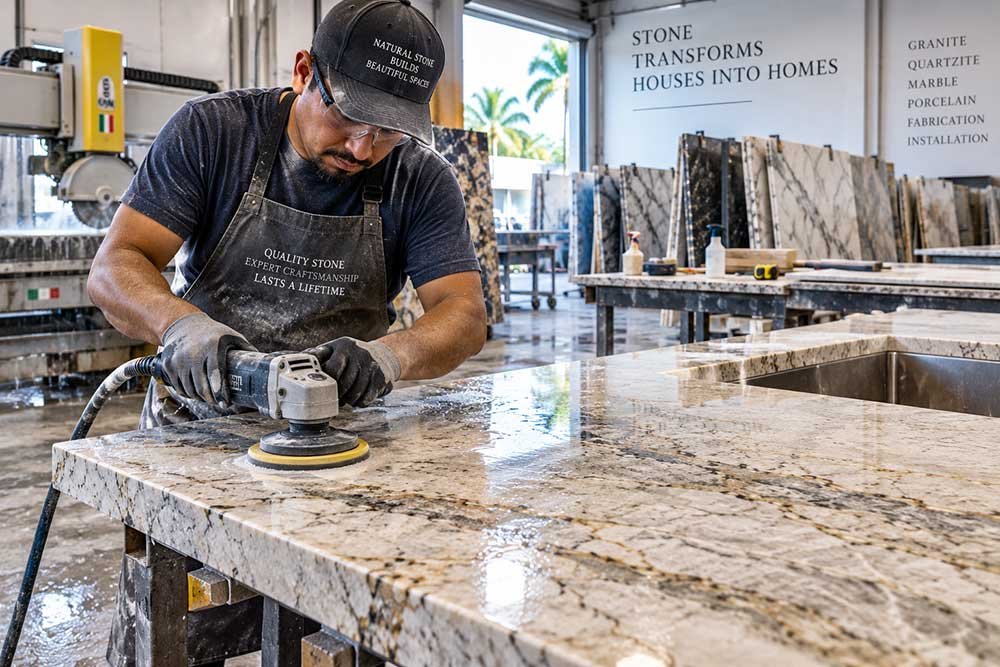
Quartzite fabrication requires accurate measurements, careful cutting, edge finishing, and precise preparation for sinks, cooktops, seams, and other project details.
Fabrication is the process of transforming a full natural-stone slab into the individual countertop pieces required for a specific kitchen, bathroom, island, bar, or other project.
Accurate measurements establish the dimensions and geometry of the finished countertop.
Countertop pieces are positioned within the slab while considering veins, movement, cutouts, seams, and material usage.
The slab is cut into the required countertop pieces using stone-fabrication equipment.
Exposed countertop edges are shaped and polished according to the selected edge profile.
Openings must be fabricated according to the project specifications and appliance or fixture requirements.
Finished pieces are prepared for transportation and installation in the home.
Many quartzites have long veins and strong directional movement.
Where countertop pieces are positioned on the slab can therefore have a major effect on the appearance of the finished kitchen.
Thoughtful slab layout can help determine where the most attractive areas appear on a large island, main countertop run, waterfall panel, backsplash, or other focal point.
This is one reason homeowners should view the entire slab rather than selecting quartzite from a small sample.
With strongly veined quartzite, the direction of the pattern should be considered before fabrication.
For example, a long vein may look best running the length of a kitchen island rather than across it.
When multiple countertop pieces meet, planning may also help create more visually natural transitions between adjacent sections.
Quartzite can create dramatic waterfall islands because the natural movement of the slab continues from the horizontal countertop down the vertical side of the island.
But the effect depends heavily on slab layout and fabrication.
If you want a waterfall island, tell the fabricator before the slab layout is finalized.
The horizontal countertop and vertical panel may need to be positioned strategically within the slab so the stone's movement transitions attractively between the two surfaces.
Some countertop layouts require seams because of slab dimensions, room geometry, transportation limitations, installation access, or other project considerations.
The goal is generally to position seams where they make sense structurally and visually.
Homeowners should discuss likely seam locations before fabrication rather than discovering them for the first time during installation.
Openings create narrower sections of stone that require accurate fabrication, proper handling, and adequate support.
Common openings include:
Sink and appliance specifications should be finalized before fabrication whenever possible.
The edge profile influences the final appearance of the countertop and can affect fabrication requirements.
| Edge Style | General Appearance |
|---|---|
| Eased Edge | Clean, simple, and versatile |
| Beveled Edge | Angular detail with a defined upper edge |
| Bullnose | Rounded and softer appearance |
| Half Bullnose | Rounded upper edge with a flatter lower portion |
| Ogee | More decorative traditional profile |
| Built-Up Edge | Creates the visual impression of a thicker countertop |
Quartzite countertops require a stable, properly prepared base.
Before installation, cabinets should be appropriately secured, level, and ready to support the countertop design.
Large overhangs, unsupported spans, special appliance openings, and other unusual conditions should be evaluated during project planning.
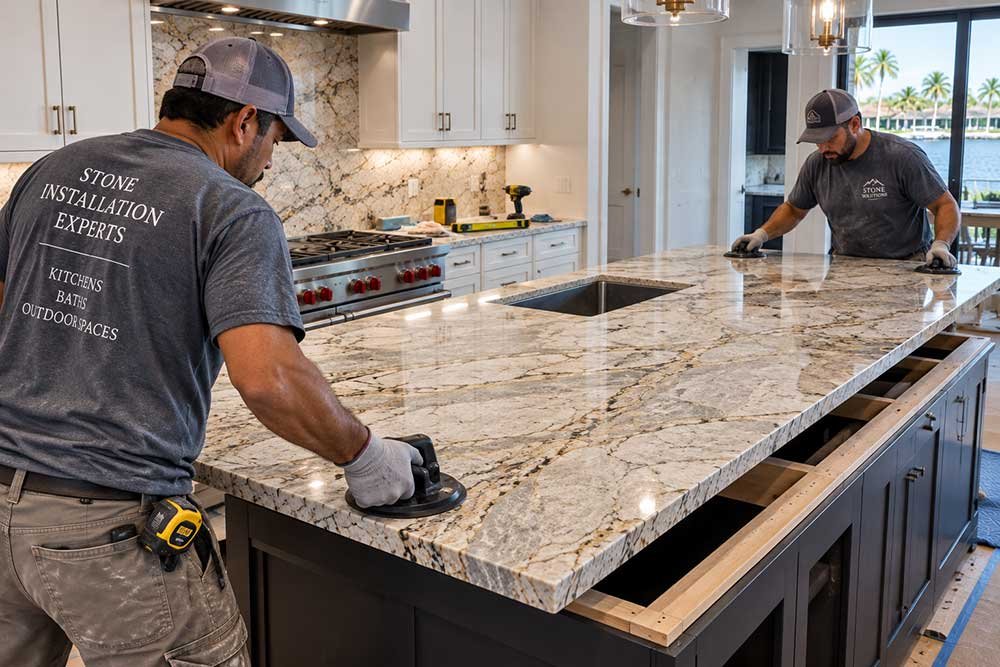
Quartzite installation involves carefully transporting, positioning, leveling, joining, and securing fabricated stone pieces within the completed countertop layout.
Once fabrication is complete, the finished stone pieces are transported to the home and carefully positioned on the prepared cabinetry.
Depending on the project, installation can include:
Plumbing, electrical work, appliance installation, cabinetry, tile, and other trades may also be involved in completing the kitchen.
The countertop project should be coordinated with the overall remodeling schedule so sinks, faucets, cooktops, appliances, backsplashes, and other components are installed in the correct sequence.
| Fabrication Decision | Effect on the Finished Countertop |
|---|---|
| Accurate Measurements | Helps the countertop fit the cabinetry and surrounding walls correctly. |
| Slab Layout | Determines where veins and important stone features appear. |
| Seam Planning | Affects both appearance and installation. |
| Cutout Fabrication | Important around sinks, cooktops, and other openings. |
| Edge Finishing | Influences the visual style and finished quality. |
| Support Planning | Helps protect large overhangs and other demanding areas. |
| Installation | Determines final fit, alignment, leveling, and seam completion. |
For homeowners planning quartzite countertops in Pompano Beach, Fort Lauderdale, Deerfield Beach, Lighthouse Point, Coral Springs, and surrounding Broward County communities, selecting the slab is only one part of the project.
The quartzite must then be accurately measured, laid out, fabricated, transported, and installed for the specific kitchen or bathroom.
Large islands, dramatic veining, waterfall panels, full-height backsplashes, and unusual layouts make careful fabrication planning even more important.
| Confirm | Why |
|---|---|
| Actual Slab | Make sure you have seen and approved the stone. |
| Slab Layout | Understand where important veins and patterns may appear. |
| Seam Locations | Know where seams are likely to be required. |
| Edge Profile | Finalize the finished countertop edge. |
| Sink | Confirm the exact sink specifications. |
| Cooktop | Confirm appliance dimensions and cutout requirements. |
| Overhangs | Determine whether additional support may be required. |
| Waterfall Panels | Include them in slab layout planning. |
| Backsplash | Determine whether additional quartzite is required. |
The finished result is a combination of stone selection, design, templating, slab layout, fabrication, support, and installation.
Choosing the right quartzite is important—but turning that slab into a countertop that fits the room and displays the stone attractively is what completes the project.
The best quartzite for a kitchen is not determined by color alone. The right slab should combine the appearance you want with the dimensions, characteristics, and performance needed for your countertop layout.
Kitchens are one of the most demanding places to install a countertop. The surface may be used every day for food preparation, cooking, serving, entertaining, small appliances, and family activities.
True quartzite can be particularly well suited to kitchens because of its hardness, scratch resistance, heat resistance, natural appearance, and potential longevity.
But there are many quartzite options. The best choice depends on how your kitchen will be used and the design you want to create.
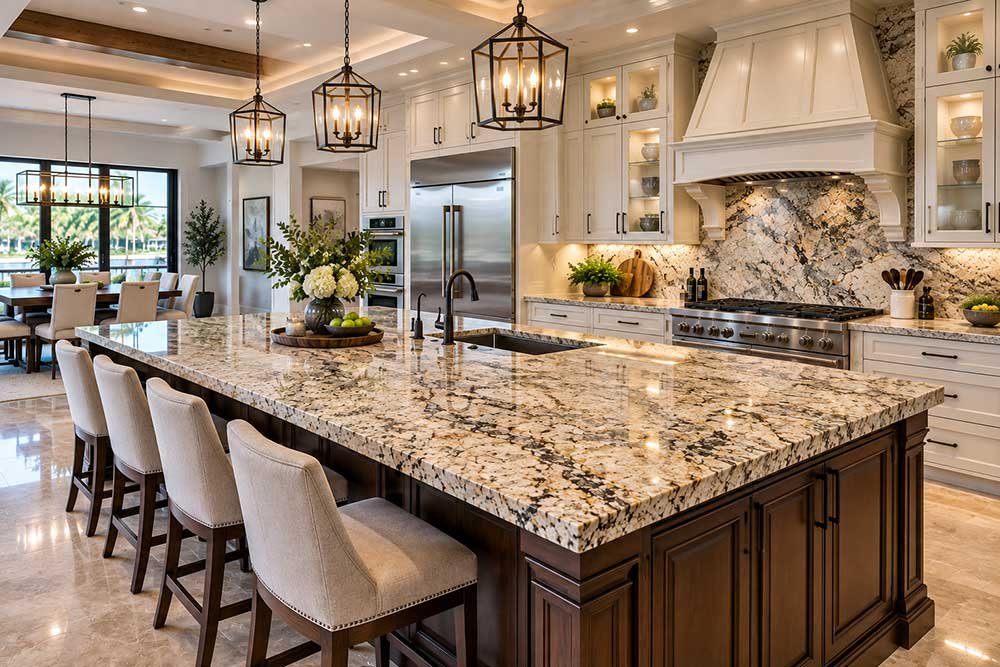
Large kitchen islands provide an opportunity to showcase the natural movement and veining of a full quartzite slab.
Understand the hardness, porosity, maintenance needs, and other characteristics of the actual slab.
Make sure the available slab dimensions work with the size of your countertops and island.
Consider how the stone's veins and movement will look across large countertop surfaces.
Compare the stone with cabinets, floors, backsplash materials, paint, hardware, and appliances.
Understand cleaning and sealing recommendations before choosing the stone.
Consider seams, sink openings, cooktops, waterfall panels, backsplashes, and edge details.
A large island creates one of the biggest uninterrupted surfaces in a kitchen.
That makes it an ideal location for displaying the natural movement of quartzite.
Instead of seeing only a narrow strip of stone along a wall, an island can display a broad portion of the slab where veins, mineral formations, and color changes become major design elements.
If you select a dramatic slab, consider using the most visually interesting portion on the kitchen island.
The perimeter countertops can then support the design while the island becomes the primary natural-stone feature.
One of the most important planning steps is comparing the finished island dimensions with the usable dimensions of the quartzite slab.
If the island is larger than the usable slab area, a seam or different design approach may be necessary.
Checking slab dimensions early can help prevent problems after cabinetry has already been ordered or installed.
Quartzite with strong directional movement should be laid out intentionally.
For a long rectangular island, homeowners may prefer the dominant movement to follow the length of the island.
The final decision depends on the individual slab and the kitchen design, but it should be considered before fabrication begins.
| Kitchen Style | Quartzite to Consider |
|---|---|
| Light Coastal | White, cream, beige, pale gray, or softly veined quartzite |
| Contemporary | Clean backgrounds with controlled movement or bold statement veining |
| Warm Transitional | Cream and beige quartzite with soft gold or warm neutral movement |
| Traditional | Warm natural patterns that coordinate with detailed cabinetry and classic finishes |
| Luxury Modern | Dramatic high-movement quartzite used as a focal-point surface |
| Natural Wood Kitchen | Warm neutral quartzite that complements the wood tone rather than competing with it |
| Dark Cabinetry | Light quartzite can create strong contrast and brighten the overall design |
Light quartzite can work especially well with white cabinetry because natural veining prevents the room from becoming visually flat.
The stone can introduce gray, beige, gold, taupe, or other subtle tones while maintaining an overall light appearance.
Homeowners should compare the actual slab directly with the cabinet color because not all whites have the same undertone.
Warm quartzites can pair naturally with wood cabinetry.
Cream, beige, taupe, and soft gold movement can connect the countertop visually with natural wood tones.
For darker wood cabinetry, lighter quartzite can also provide contrast and help keep the kitchen feeling open.
Taj Mahal is often considered when homeowners want a light natural stone without the appearance of a stark white countertop.
Its typical cream, beige, and warm neutral movement can coordinate with many cabinet and flooring colors.
This can make it particularly useful in kitchens combining white or cream cabinetry, natural wood, warm flooring, brass-tone hardware, or neutral backsplashes.
As always, compare the actual slab because natural variation can be significant.
A waterfall island extends quartzite vertically down one or both ends of the island.
This can be especially dramatic when the slab contains long veins that can visually continue from the countertop into the vertical panel.
Waterfall designs require additional material and careful fabrication planning, so they should be discussed before slab layout begins.
Using the same quartzite for both countertops and a full-height backsplash can create a continuous natural-stone appearance.
This can work particularly well behind a cooktop or range where the vertical slab becomes a focal point.
If you want a quartzite backsplash, include it when calculating the number of slabs required for the project.
Some kitchens use quartzite only on the island and another complementary surface on the perimeter—or the reverse.
This can help control the budget while allowing a distinctive quartzite slab to become the visual centerpiece of the room.
A kitchen countertop should be selected for both appearance and function.
| Kitchen Activity | Quartzite Consideration |
|---|---|
| Food Preparation | Excellent hardness; continue using cutting boards. |
| Cooking | Excellent natural heat resistance; trivets remain recommended. |
| Entertaining | Large stone surfaces provide durable serving and gathering areas. |
| Children & Family Use | Durable natural stone can handle normal everyday activity. |
| Small Appliances | Hard surface works well for frequently used kitchen equipment. |
| Spills | Clean promptly and follow sealing recommendations for the specific stone. |
For kitchens in Pompano Beach, Fort Lauderdale, Deerfield Beach, Lighthouse Point, Coral Springs, and surrounding Broward County communities, quartzite can work particularly well with the light, open layouts common in many South Florida renovations.
Large islands, open kitchens, waterfront homes, contemporary interiors, and coastal-inspired designs provide opportunities to make the natural stone a major part of the room.
Rather than choosing quartzite solely because it is popular or because of a stone name, select the slab that works with the architecture, colors, lighting, and everyday use of your specific home.
| Before You Buy | Check |
|---|---|
| View the entire slab | ✓ |
| Compare it with cabinet colors | ✓ |
| Compare it with flooring | ✓ |
| Check slab dimensions against the island | ✓ |
| Review vein direction | ✓ |
| Discuss seam locations | ✓ |
| Confirm sink and cooktop locations | ✓ |
| Decide whether you want waterfall panels | ✓ |
| Decide whether you want a stone backsplash | ✓ |
| Understand maintenance and sealing requirements | ✓ |
The best quartzite is the specific slab that provides the appearance you want, has characteristics appropriate for kitchen use, fits your countertop layout, and works within your total project budget.
For large islands and heavily veined stone, seeing the full slab and planning the layout before fabrication are especially important.
Quartzite can be an excellent natural-stone option for outdoor kitchens, but South Florida installations require more than simply choosing an attractive slab.
Outdoor kitchens are a major part of the South Florida lifestyle, allowing cooking and entertaining areas to extend beyond the interior of the home.
Countertops in these spaces face conditions that indoor countertops do not, including direct sunlight, rain, humidity, heat, wind-driven weather, temperature changes, and outdoor cooking activity.
Natural quartzite can be considered for outdoor countertops because of its hardness and heat resistance, but the actual stone, finish, fabrication, installation system, treatments, and exposure conditions should all be evaluated before the material is selected.
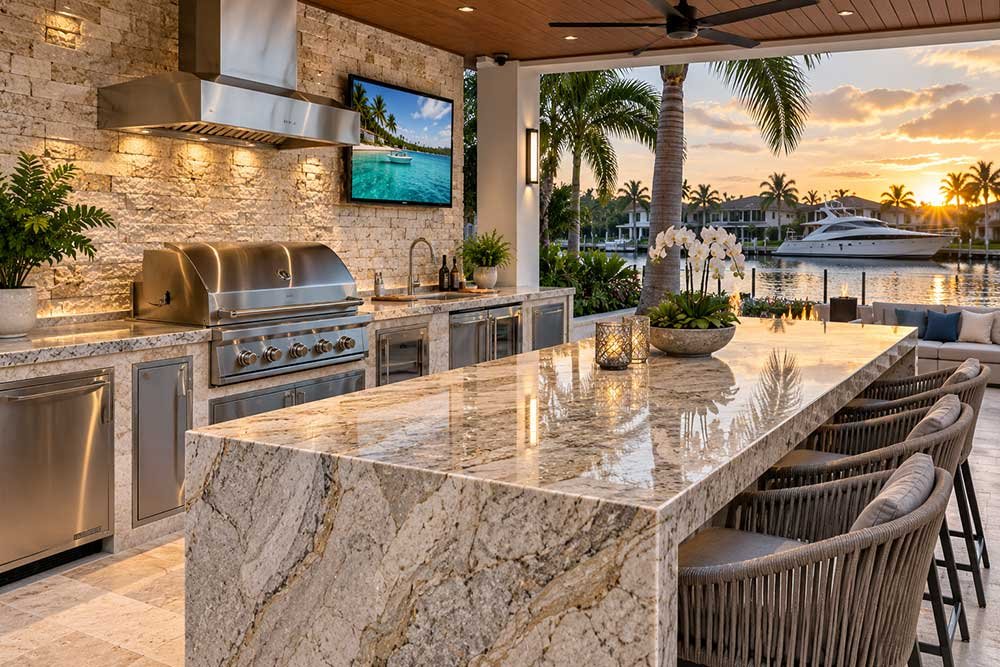
An outdoor kitchen countertop must be selected for both appearance and exposure to South Florida's outdoor environment.
Quartzite has several characteristics that can make it attractive for outdoor countertop applications.
Quartzite is formed naturally rather than manufactured from a mixture of stone and resin.
True quartzite is a hard natural stone that can perform well in demanding countertop applications.
Natural quartzite has strong heat resistance, an important consideration around outdoor cooking areas.
Natural veining and variation can make an outdoor kitchen feel connected to the surrounding landscape and architecture.
Slabs can provide broad countertop surfaces with fewer visual interruptions than many smaller-format materials.
Available colors can complement pools, patios, outdoor cabinetry, pavers, and exterior finishes.
| Outdoor Condition | Why It Matters |
|---|---|
| Strong Sunlight | The countertop and any treatments may receive prolonged UV exposure. |
| Heavy Rain | Outdoor surfaces may experience repeated direct water exposure. |
| Humidity | Outdoor installations remain exposed to humid conditions for extended periods. |
| High Temperatures | Countertops can become hot from both sunlight and nearby cooking equipment. |
| Wind-Driven Weather | Rain and debris may reach areas that are normally protected by a roof or overhang. |
| Outdoor Cooking | Grease, oils, sauces, beverages, and food spills can contact the countertop. |
| Coastal Exposure | Properties near the coast may require additional consideration of the complete outdoor installation environment. |
Natural quartzite itself does not depend on a manufactured resin binder in the way some engineered countertop products do.
However, an outdoor countertop is more than the raw stone.
The slab may include natural fissures, filled areas, surface treatments, sealers, adhesives, seam materials, or other components whose outdoor performance should also be considered.
For an outdoor installation, do not evaluate only the stone.
The quartzite, fillers, finish, sealer, seams, adhesives, support structure, cabinetry, and installation method should all be appropriate for the intended environment.
This becomes particularly important when selecting natural stone for an outdoor application.
Stone names used in the marketplace do not always correspond perfectly with geological classifications.
A material sold under a quartzite name may have different characteristics from another slab carrying a similar commercial description.
The actual stone should therefore be evaluated rather than assuming that every slab labeled “quartzite” will perform identically outdoors.
Some quartzites may benefit from an appropriate penetrating sealer, depending on the stone's porosity and the intended application.
Outdoor sealing decisions should be based on the specific stone and a product suitable for the exposure conditions.
Sealing does not make a countertop maintenance-free or completely stain-proof.
Grease, cooking oils, wine, sauces, and other spills should still be cleaned promptly.
Not every outdoor kitchen experiences the same amount of exposure.
A roof or substantial overhang can reduce direct exposure to sunlight and rain, although humidity and wind-driven weather remain considerations.
Different sections of the countertop may receive very different levels of sun and rain throughout the day.
The stone and installation system must tolerate the greatest direct exposure to sunlight, rain, and outdoor conditions.
Outdoor kitchens often incorporate built-in grills, side burners, pizza ovens, refrigerators, sinks, ice makers, and other equipment.
Countertop openings and clearances should be fabricated according to the specifications of the equipment being installed.
The countertop should not be used as a substitute for required heat shields, insulation, clearances, or other installation components specified by the appliance manufacturer.
Before the quartzite is cut, confirm the exact models and specifications for built-in equipment whenever possible.
This can include:
Accurate appliance information allows countertop openings and surrounding stone to be planned before fabrication begins.
Outdoor countertops should coordinate with more than the cabinetry.
Consider the stone alongside:
Viewing the actual slab is especially helpful because natural stone can look different under strong daylight than it does under indoor showroom lighting.
Both can work aesthetically, but color affects the appearance and experience of the outdoor space.
Light cream, beige, white, and gray stones can complement coastal and contemporary South Florida designs.
Darker stone can create dramatic contrast but may become noticeably hot when exposed to strong direct sunlight.
The best choice depends on the location of the outdoor kitchen, amount of shade, surrounding materials, and overall design.
Outdoor countertops should be designed and installed so water is not unnecessarily trapped around appliances, seams, cabinetry, or other components.
After storms or heavy use, removing standing water, food residue, grease, leaves, and other debris can help keep the countertop and surrounding outdoor kitchen cleaner.
| Situation | Recommended Approach |
|---|---|
| Food & Beverage Spills | Clean promptly using a method appropriate for natural stone. |
| Grease & Cooking Oil | Do not allow oily residue to remain unnecessarily. |
| Leaves & Debris | Remove regularly rather than allowing organic material to accumulate. |
| Standing Water | Wipe away when practical and investigate areas where water repeatedly collects. |
| Routine Cleaning | Use nonabrasive, stone-appropriate cleaning products. |
| Sealing | Follow recommendations appropriate for the specific stone and outdoor exposure. |
Outdoor kitchens are common additions to homes throughout Pompano Beach, Fort Lauderdale, Deerfield Beach, Lighthouse Point, Coral Springs, and other Broward County communities.
In South Florida, the countertop should be selected with the actual location in mind.
A covered patio in Coral Springs may create a different exposure environment than an uncovered waterfront outdoor kitchen in Pompano Beach or Lighthouse Point.
Sun orientation, roof coverage, proximity to the coast, appliance layout, drainage, and surrounding construction should all be considered along with the appearance of the quartzite.
| Question | Confirm |
|---|---|
| Is the actual stone appropriate for the application? | ✓ |
| Will the countertop be covered or uncovered? | ✓ |
| How much direct sunlight will it receive? | ✓ |
| Are sealers and other treatments appropriate for outdoor use? | ✓ |
| Are the grill and appliance models finalized? | ✓ |
| Are appliance clearances properly planned? | ✓ |
| Is the support structure appropriate? | ✓ |
| Has water exposure and drainage been considered? | ✓ |
| Have you viewed the slab in natural light? | ✓ |
Quartzite can be an excellent natural-stone option for an outdoor kitchen when the actual stone and complete installation are appropriate for the environment.
For South Florida homes, consider sunlight, rain, humidity, cooking equipment, maintenance, stone characteristics, sealers, support, and installation details before making the final selection.
The goal is not simply to choose a beautiful quartzite slab—it is to choose a stone and installation system suited to the specific outdoor kitchen where it will be used.
Taj Mahal quartzite is known for its warm, light appearance and flowing natural movement. Before choosing it for a South Florida home, compare the actual slabs, understand natural variation, and plan how the stone will be fabricated.
Among the many natural stones homeowners encounter while shopping for countertops, Taj Mahal quartzite is distinctive because it combines a relatively light overall appearance with warm cream, beige, taupe, and subtle gold-toned movement.
That combination can make it easier to coordinate with a wide range of cabinet colors, flooring, hardware, and interior styles.
But Taj Mahal is still natural stone. One slab can look noticeably different from another, so homeowners should select the actual slab rather than relying solely on a small sample, photograph, or stone name.
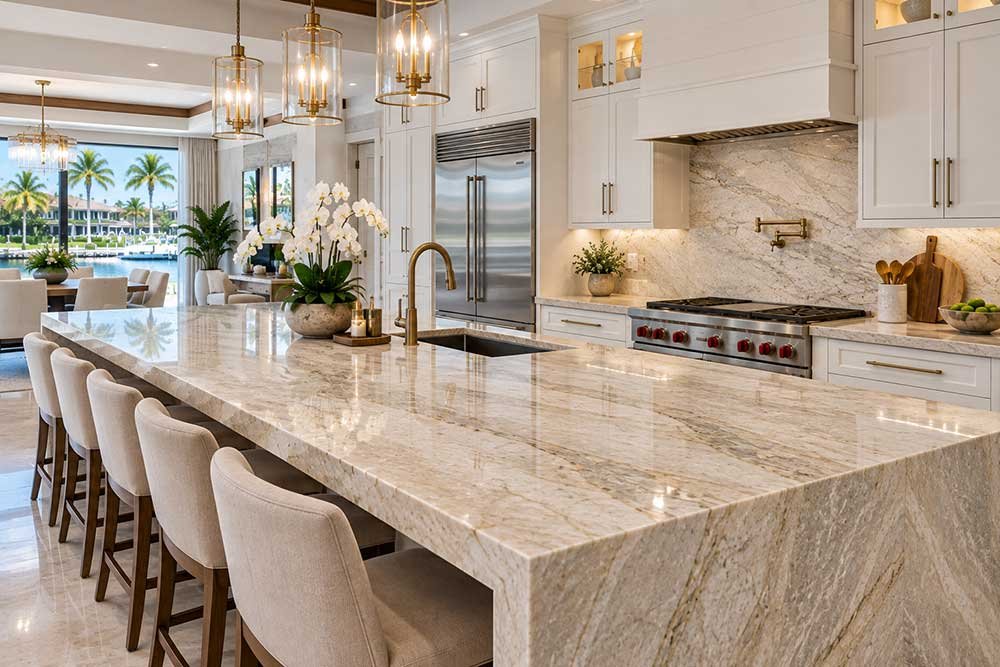
Taj Mahal quartzite can combine a light neutral background with warm natural movement that works with many kitchen color palettes.
Taj Mahal quartzite typically has a warm neutral appearance rather than the cooler gray-and-white look associated with some other natural stones.
Individual slabs can include combinations of:
The pattern may range from subtle flowing movement to more noticeable veins and mineral variation.
| Characteristic | What to Expect |
|---|---|
| Overall Color | Generally light and warm |
| Common Tones | Cream, beige, taupe, off-white, soft gray, and warm movement |
| Pattern | Natural flowing movement and veining that varies by slab |
| Design Character | Warm, natural, understated to moderately dramatic |
| Common Applications | Kitchen countertops, islands, vanities, bars, backsplashes, and other stone surfaces |
| Maintenance | Routine natural-stone care and sealing when appropriate for the specific slab |
One of its strongest design advantages is versatility.
Taj Mahal can provide natural movement without necessarily dominating the entire kitchen. This can make it useful when homeowners want a natural-stone focal point while keeping the overall room warm and balanced.
Cream and beige tones can coordinate with many cabinet, floor, and backsplash colors.
Every slab contains its own combination of veins, mineral formations, and tonal changes.
It can help maintain a bright kitchen without requiring a completely white countertop.
A broad island can display the stone's flowing movement across a large uninterrupted surface.
It can work with contemporary, transitional, coastal, and more traditional interiors.
Variation between slabs gives each completed countertop a unique appearance.
White cabinetry and Taj Mahal quartzite can create a light kitchen without making every surface the same shade of white.
The warmer movement in the stone can introduce subtle contrast and help connect white cabinets with wood floors, brass-tone hardware, beige tile, or other warmer finishes.
White paint colors can have warm, cool, gray, cream, or blue undertones.
Bring an actual cabinet or finish sample when selecting stone whenever possible. The combination is easier to judge when the materials are viewed together.
The warm neutral movement found in many Taj Mahal slabs can also complement natural wood cabinetry.
Depending on the particular slab, it may work with light oak, medium wood tones, darker cabinetry, or kitchens that combine painted cabinets with a natural-wood island.
The important factor is the undertone of the actual materials—not simply their names.
Because Taj Mahal often contains multiple neutral tones, several hardware finishes may work successfully depending on the slab and cabinetry.
| Hardware Finish | Potential Design Effect |
|---|---|
| Brass / Warm Metallic | Can emphasize warmer gold and beige tones in the stone |
| Black | Creates stronger contrast against a light countertop |
| Nickel | Can coordinate with cooler gray or neutral movement |
| Stainless Steel | Can connect the countertop visually with kitchen appliances |
Large islands can be particularly effective locations for Taj Mahal because they expose a broad portion of the slab.
Before fabrication, review how the major veins will run across the island and where the most visually interesting portions of the stone will appear.
If the island is especially large, compare its dimensions with the usable dimensions of the available slabs before finalizing the cabinetry.
A waterfall edge can extend Taj Mahal quartzite down the side of an island and make the natural stone more prominent in the room.
If this design is planned, slab layout becomes especially important because the horizontal countertop and vertical panel should be considered together before the stone is cut.
Using Taj Mahal for both the countertop and a full-height backsplash can create a continuous natural-stone design.
This approach can be particularly effective behind a cooktop or range, where the slab becomes a vertical focal point.
Because a full-height backsplash requires additional material, include it when determining how many slabs the project may require.
No.
Natural variation is one of the defining characteristics of stone.
Two slabs sold under the Taj Mahal name may differ in:
If you want Taj Mahal quartzite, inspect the actual full slabs being considered for your project.
A photograph or small sample cannot show how the pattern will appear across a large island or an entire kitchen.
Lighting can influence how the stone appears.
Natural daylight, warm interior lighting, and cooler artificial lighting may emphasize different tones within the slab.
This is particularly important when coordinating the stone with cabinets, flooring, wall colors, and backsplash materials.
Routine care is generally similar to the quartzite maintenance discussed earlier in this guide.
Use appropriate natural-stone cleaning methods, clean spills promptly, avoid unnecessarily abrasive or aggressive products, and follow sealing recommendations appropriate for the actual stone.
Do not assume that every slab requires exactly the same sealing schedule.
The total project price can depend on the available slabs and the requirements of the countertop design.
Factors can include:
For that reason, compare the complete fabricated and installed project rather than evaluating the stone only by an advertised material price.
| Check | Why It Matters |
|---|---|
| View the Full Slab | Natural variation can be significant. |
| Compare Cabinet Samples | Helps confirm color and undertone compatibility. |
| Compare Flooring | The countertop should work with the entire room. |
| Check Slab Dimensions | Important for large islands and long countertop runs. |
| Review Vein Direction | Influences the appearance of the finished countertop. |
| Plan Seams | Know where multiple countertop sections may meet. |
| Plan Waterfalls | Requires additional stone and careful slab layout. |
| Plan Backsplash Material | A full-height quartzite backsplash may require additional slabs. |
| Understand Care Requirements | Know how the specific stone should be cleaned and maintained. |
For homeowners in Pompano Beach, Fort Lauderdale, Deerfield Beach, Lighthouse Point, Coral Springs, and throughout Broward County, Taj Mahal quartzite can work especially well with the bright, open interiors found in many South Florida homes.
Its warm neutral appearance can complement white cabinetry, natural wood, light flooring, coastal-inspired interiors, and contemporary kitchen designs without requiring a completely white countertop.
For large islands and open floor plans, careful slab selection and layout allow the natural movement of the stone to become part of the overall architecture of the room.
It can be an excellent choice for homeowners who want a light natural stone with warmer, softer movement than many gray-and-white countertop materials.
The most important step is to evaluate the actual slab and make sure its color, pattern, dimensions, characteristics, and maintenance requirements fit your particular project.
With natural stone, the name identifies the general material you are considering—but the individual slab is what ultimately becomes your countertop.
Choosing quartzite should involve more than finding a color you like. The actual slab's pattern, dimensions, natural characteristics, finish, and relationship to your kitchen design can all affect the finished countertop.
Natural stone is different from a manufactured countertop product because every slab is unique.
Even slabs sold under the same quartzite name can have noticeable differences in background color, vein direction, movement, mineral markings, and other natural characteristics.
That makes viewing and evaluating the actual full slab one of the most important steps in choosing quartzite countertops.
Viewing full quartzite slabs allows homeowners to evaluate color, veining, movement, dimensions, and natural variation before fabrication begins.
A small stone sample can help you understand the general color of a material, but it cannot show the complete pattern of a full slab.
A sample may contain only a few inches of a vein that stretches several feet across the actual stone.
Likewise, one portion of a slab may be relatively quiet while another contains dramatic movement.
When natural movement is important to the design, make your final decision using the actual slab whenever possible.
Determine whether the overall stone is white, cream, beige, gray, green, blue, or another dominant color.
Look at the colors running through the slab and how they coordinate with the rest of the room.
Directional movement can influence how the stone should be positioned on islands and long countertop runs.
Decide whether you prefer a quieter slab or a more dramatic natural pattern.
Confirm that the usable slab dimensions work with the countertop layout.
Inspect fissures, mineral variation, filled areas, and other features present in the actual stone.
One of the best ways to evaluate quartzite is to compare it directly with the materials already selected for the room.
If possible, bring a cabinet door or finish sample when viewing slabs.
This is particularly useful with white and cream cabinetry because subtle undertone differences can become more noticeable when the materials are placed next to each other.
| Sample | What It Helps You Evaluate |
|---|---|
| Cabinet Door | Color and undertone compatibility |
| Flooring | Whether warm and cool tones work together |
| Backsplash | Pattern, color, and visual balance |
| Paint Color | Relationship between walls and countertop |
| Hardware Finish | How metallic finishes relate to the stone's colors |
| Appliance Finish | How stainless, black, white, or specialty finishes coordinate |
A quartzite slab can look different under showroom lighting than it does inside your kitchen.
Natural daylight, warm LED lighting, cool lighting, and the amount of sunlight entering the room can all affect how the stone's colors are perceived.
If your kitchen receives significant natural light, consider how the slab's colors may appear throughout the day.
There is no universally correct choice.
Some homeowners want the countertop to act as a subtle background material. Others want the stone to become the main visual feature of the kitchen.
Can work well when cabinetry, backsplash, lighting, or architectural details are already visually strong.
Can become the focal point when used on a large island, backsplash, waterfall panel, or open countertop surface.
A beautiful slab is not automatically the right slab for your project.
The usable dimensions must work with the countertop pieces that need to be fabricated.
This becomes especially important for:
Before fabrication, consider where the island, perimeter countertops, backsplash, and other pieces will be positioned within the slab.
This allows the stone's most attractive areas to be used intentionally rather than leaving important visual decisions until after cutting begins.
When a kitchen requires multiple slabs, compare them together whenever possible.
Look for reasonable compatibility in:
The slabs do not need to be identical—natural stone rarely is—but understanding how they relate to each other can help with layout planning.
When several slabs are available from the same block or production sequence, their patterns may have visual relationships that can be useful for larger projects.
This can be especially helpful when planning adjacent countertops, large islands, waterfall panels, or full-height backsplashes.
Natural stone can contain mineral changes, veins, fissures, pits, filled areas, and other characteristics formed during the stone's geological history or addressed during slab processing.
These should be evaluated as part of the actual slab rather than assuming that every visual line is a defect.
If you see an area you do not understand, ask about it before purchasing or approving the slab.
Once a slab has been cut, changing your mind becomes much more difficult.
Review the stone, discuss areas that concern you, and understand the proposed layout before fabrication begins.
Quartzite may be available in different surface finishes depending on the stone and supplier.
| Finish | General Appearance |
|---|---|
| Polished | Smooth, reflective surface that emphasizes color and pattern |
| Honed | Lower-sheen appearance with a softer visual effect |
| Textured / Specialty Finish | Appearance and texture vary depending on the stone and finishing process |
Different finishes may affect appearance and maintenance, so understand the specific finish you are selecting.
Natural-stone names are useful for identifying and discussing materials, but they should not replace inspection of the actual slab.
Two slabs carrying the same commercial name can still have different colors, patterns, and natural characteristics.
In addition, marketplace stone terminology can sometimes be inconsistent.
If performance characteristics are important to the application, evaluate the actual material rather than relying entirely on the name attached to it.
| Question | Why Ask It? |
|---|---|
| Is this the actual slab that will be used? | Confirms you are approving the stone for your project. |
| Will my island fit on one slab section? | Helps determine whether a seam may be required. |
| How many slabs will my project require? | Important for layout and budgeting. |
| Where are the likely seams? | Allows you to understand the finished layout. |
| Which direction will the veins run? | Important for islands and strongly patterned stone. |
| Are there areas of the slab we should discuss? | Helps identify natural features before cutting. |
| What finish does the slab have? | Affects appearance and maintenance. |
| Does this stone have specific care requirements? | Helps you understand long-term maintenance. |
For homeowners selecting quartzite countertops in Pompano Beach, Fort Lauderdale, Deerfield Beach, Lighthouse Point, Coral Springs, and throughout Broward County, viewing full slabs can be especially valuable for large open kitchens and oversized islands.
South Florida interiors often combine strong natural light, light cabinetry, open floor plans, outdoor views, and large entertaining spaces.
Seeing the full slab allows you to evaluate how its color and movement will work with those existing design elements before fabrication begins.
| Before Approving the Slab | Check |
|---|---|
| View the full slab | ✓ |
| Confirm the slab identification | ✓ |
| Compare cabinet colors | ✓ |
| Compare flooring and backsplash materials | ✓ |
| Check slab dimensions | ✓ |
| Review major veins and movement | ✓ |
| Discuss natural characteristics | ✓ |
| Review proposed seam locations | ✓ |
| Discuss island and waterfall layout | ✓ |
| Understand the surface finish | ✓ |
| Understand care and sealing recommendations | ✓ |
Evaluate the actual full slab before it is fabricated.
Color, veining, dimensions, natural characteristics, and pattern placement can all influence the finished countertop.
A carefully selected slab combined with thoughtful fabrication planning gives you much greater control over how the quartzite will ultimately look in your home.
Quartzite and granite are both durable natural-stone countertop materials. The better choice depends on the appearance you prefer, the individual slab, your kitchen design, maintenance expectations, and the specific application.
Homeowners comparing natural-stone countertops frequently narrow their choices to quartzite and granite.
Both materials can provide durable, long-lasting countertop surfaces, and both are available in a wide variety of natural colors and patterns.
The biggest differences often come down to appearance, individual stone characteristics, availability, project requirements, and personal preference rather than one material being universally better than the other.
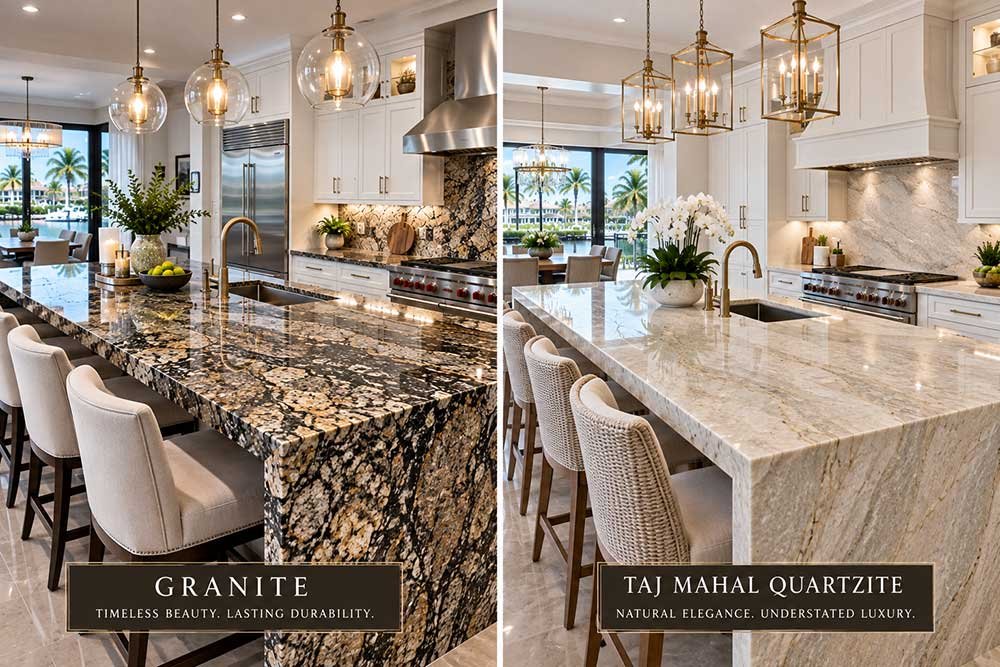
Granite and quartzite can both create durable natural-stone kitchens, but the colors, patterns, and movement of the individual slabs can be very different.
Choose quartzite when you find a slab whose natural movement and appearance are central to your kitchen design.
Choose granite when you prefer the colors, mineral patterns, availability, or overall value offered by a particular granite slab.
For durability, both can be excellent countertop materials when the actual stone is appropriate for the application and is properly fabricated, installed, and maintained.
| Feature | Quartzite | Granite |
|---|---|---|
| Material Type | Natural metamorphic stone | Natural igneous stone |
| Hardness | Generally very hard | Generally very hard and durable |
| Heat Resistance | Excellent natural heat resistance | Excellent natural heat resistance |
| Scratch Resistance | Generally excellent | Generally excellent |
| Appearance | Often flowing, directional, or marble-like movement | Ranges from fine mineral patterns to dramatic movement and veining |
| Color Range | Wide natural range | Extremely wide natural range |
| Sealing | Depends on the specific stone and porosity | Depends on the specific stone and porosity |
| Natural Variation | Yes | Yes |
| Large Islands | Excellent when slab dimensions and layout work | Excellent when slab dimensions and layout work |
| Outdoor Potential | Can be appropriate depending on the actual stone and installation | Can be appropriate depending on the actual stone and installation |
Appearance is often the biggest reason a homeowner chooses one material over the other.
Many quartzites feature long, flowing veins and broad movement that can resemble the visual character homeowners associate with marble.
Granite often displays more visible mineral crystals, speckling, waves, or complex patterns, although some granites can also have dramatic directional movement.
Often chosen for flowing movement, light backgrounds, dramatic veins, and natural patterns that can become a focal point.
Offers an enormous variety of mineral patterns, colors, movement, and visual textures.
Both granite and true quartzite are durable natural stones capable of performing well in busy kitchens.
Quartzite is known for its hardness, while granite has a long history of successful use as a kitchen countertop material.
In practical residential use, the condition and characteristics of the actual slab, fabrication quality, installation, support, and homeowner care can matter more than trying to declare one entire stone category the winner.
Both materials generally provide strong scratch resistance under normal kitchen use.
However, homeowners should continue using cutting boards.
Cutting directly on stone can damage knife edges and creates unnecessary wear on the countertop and surrounding surface treatments.
Both quartzite and granite have excellent natural heat resistance.
That makes both materials attractive around cooking areas.
Natural stone may tolerate heat well, but using trivets or heat-resistant pads protects the complete countertop system—including sealers, seams, surrounding materials, and nearby finishes—from unnecessary thermal stress.
Stain resistance varies because both granite and quartzite are natural materials and their porosity is not identical from slab to slab.
Some stones absorb liquids more readily than others.
When appropriate, a penetrating sealer can help reduce liquid absorption, but sealing does not make either material completely stain-proof.
With both materials, clean spills promptly.
For most homeowners, routine care for granite and quartzite is similar.
| Maintenance | Quartzite | Granite |
|---|---|---|
| Routine Cleaning | Simple | Simple |
| Stone-Safe Cleaner | Recommended | Recommended |
| Prompt Spill Cleanup | Recommended | Recommended |
| Sealing | As appropriate for the specific stone | As appropriate for the specific stone |
| Cutting Boards | Recommended | Recommended |
| Trivets | Recommended | Recommended |
Sometimes—but not always.
There are many varieties of both granite and quartzite, and material pricing can vary substantially.
The total installed price also depends on:
Compare actual project quotes rather than assuming one material category will always cost more than the other.
Both can be excellent.
For a large island, the more important questions are:
Quartzite often receives attention for large islands because strongly veined slabs can create dramatic continuous movement across the surface.
But a distinctive granite slab can create an equally strong focal point.
Both materials can work with white cabinetry.
Light quartzites can create a soft, flowing appearance, while granite can introduce anything from subtle neutral mineral patterns to strong contrast.
Compare the actual cabinet sample with the actual stone rather than choosing based solely on the material category.
Both natural stones may be considered for outdoor applications, but neither should be selected solely because of its category name.
The actual stone, finish, fillers, treatments, sealers, fabrication, support, appliance layout, and installation environment should be evaluated.
For South Florida outdoor kitchens, exposure to sunlight, rain, humidity, cooking activity, and potentially coastal conditions should be part of the selection process.
The most useful comparison is often not:
“Is quartzite better than granite?”
It is:
“Is this quartzite slab better for my project than this granite slab?”
That approach considers the actual color, pattern, dimensions, natural characteristics, cost, and suitability of the materials available for your home.
| If Your Priority Is... | Consider... |
|---|---|
| Flowing, marble-like natural movement | Quartzite |
| Very broad range of mineral patterns and colors | Granite |
| Excellent natural-stone durability | Either |
| Excellent heat resistance | Either |
| Large statement island | Compare the actual slabs |
| Outdoor kitchen | Evaluate the specific stone and installation |
| Lowest project price | Compare available slabs and complete installed quotes |
| Unique natural appearance | Either |
For homeowners in Pompano Beach, Fort Lauderdale, Deerfield Beach, Lighthouse Point, Coral Springs, and throughout Broward County, both quartzite and granite can be excellent choices for kitchens, bathrooms, bars, and other countertop projects.
Light quartzites can complement the bright, open interiors common in many South Florida renovations, while granite provides an exceptionally broad selection of colors and natural patterns.
Instead of deciding between the materials before seeing the stone, compare full slabs of both. The right slab may become obvious once you see how it works with your cabinetry, flooring, lighting, and overall home design.
Neither material is automatically better for every homeowner.
Quartzite and granite are both durable natural stones capable of creating long-lasting countertops.
If you prefer flowing natural movement and find a quartzite slab that fits your design, quartzite may be the better choice. If a granite slab provides the color, pattern, availability, and value you prefer, granite may be the better choice.
The best decision comes from comparing the actual slabs, actual project requirements, and complete fabricated and installed cost.
From selecting the right slab to planning the layout, fabrication, and installation, a successful quartzite countertop project depends on both the natural stone you choose and how that stone is transformed into the finished countertop.
If you are considering quartzite countertops in South Florida, the process should begin with more than choosing a stone color from a photograph.
The actual slab, kitchen dimensions, vein direction, seams, edges, sink and appliance openings, backsplashes, waterfall panels, and installation requirements all contribute to the finished result.
Absolute Marble & Granite helps homeowners turn natural-stone slabs into finished countertop surfaces for kitchens, bathrooms, islands, bars, and other residential applications.

Careful fabrication helps transform a selected quartzite slab into countertops designed for the dimensions and layout of the individual project.
The stone you see as a full slab must be carefully planned and fabricated before it becomes part of your home.
Compare full quartzite slabs and evaluate color, veining, movement, dimensions, and natural characteristics.
Review cabinetry, countertop dimensions, appliances, sinks, backsplashes, islands, and other design requirements.
Consider how the important areas of the slab will appear across islands, perimeter countertops, seams, backsplashes, and waterfall panels.
The slab is cut and finished according to the approved dimensions, openings, edges, and project requirements.
Cabinetry, supports, appliances, access, and other site conditions should be coordinated before installation.
The fabricated pieces are positioned, joined where necessary, and completed according to the project layout.
A beautiful quartzite slab provides the raw material, but fabrication determines how that stone becomes part of your kitchen or bathroom.
Thoughtful slab layout can influence vein direction, focal areas, seam placement, waterfall transitions, backsplash appearance, and how the finished countertop relates to the rest of the room.
Quartzite can be considered for a wide variety of residential stone projects.
| Application | Important Planning Considerations |
|---|---|
| Kitchen Countertops | Layout, sinks, cooktops, seams, edges, and daily use |
| Large Kitchen Islands | Slab dimensions, vein direction, overhangs, and support |
| Waterfall Islands | Additional material and pattern coordination |
| Full-Height Backsplashes | Slab quantity, outlets, pattern placement, and adjoining countertops |
| Bathroom Vanities | Sink openings, cabinetry, edge details, and maintenance |
| Bars & Entertainment Areas | Dimensions, sinks, appliances, and overall room design |
| Outdoor Kitchens | Actual stone characteristics, exposure, support, finish, and installation environment |
Before discussing your project, gather as much information as possible about the space.
Absolute Marble & Granite works with homeowners considering quartzite and other countertop materials for projects throughout Pompano Beach, Fort Lauderdale, Deerfield Beach, Coral Springs, Lighthouse Point, Broward County, and surrounding South Florida communities.
Whether you are planning a new kitchen, replacing existing countertops, designing a large island, renovating a bathroom, or considering natural stone for another part of your home, the process begins with understanding the material and the requirements of the project.
| Quartzite Buying Principle | Why It Matters |
|---|---|
| View the full slab | Natural stone varies from slab to slab |
| Confirm the material | Quartzite and engineered quartz are different products |
| Compare slab dimensions | Large islands and other pieces must fit within usable stone |
| Review vein direction | Pattern placement affects the finished appearance |
| Discuss seams | Know how separate countertop pieces may meet |
| Plan waterfalls early | They affect slab quantities and layout |
| Plan stone backsplashes early | They may require additional material |
| Understand maintenance | Care and sealing requirements depend on the actual stone |
| Consider fabrication | The quality of the finished project depends on more than the slab itself |
Homeowners considering quartzite countertops in Pompano Beach, Fort Lauderdale, Deerfield Beach, Coral Springs, Lighthouse Point, Broward County, and surrounding South Florida communities can contact Absolute Marble & Granite to discuss their countertop project.
The process can include reviewing the project requirements, comparing stone options, planning the countertop layout, fabrication, and installation.
If you are comparing quartzite slabs or planning a kitchen, bathroom, island, or other countertop project, contact Absolute Marble & Granite to discuss the material and your project requirements.
Contact Absolute Marble & Granite
Call: (954) 781-7370
Serving homeowners in Pompano Beach, Fort Lauderdale, Deerfield Beach, Coral Springs, Lighthouse Point, Broward County, and surrounding South Florida communities.
Quartzite can be an outstanding countertop material when the right slab is matched with the right project.
Its combination of natural variation, hardness, heat resistance, and distinctive movement makes it worth considering for everything from large kitchen islands to bathroom vanities and other stone surfaces.
But the best results begin before the first cut is made: select the actual slab carefully, understand its characteristics, plan the layout, and coordinate the fabrication and installation around the requirements of your home.